Mental Fitness Mondays: Thinking Fast...and Slow…or Just Slow?
7th September 2026Mental Agility
Today I’m sharing my (slow) thoughts on a study that impacts one of your mental fitness muscles: mental agility.
Let’s take it slow
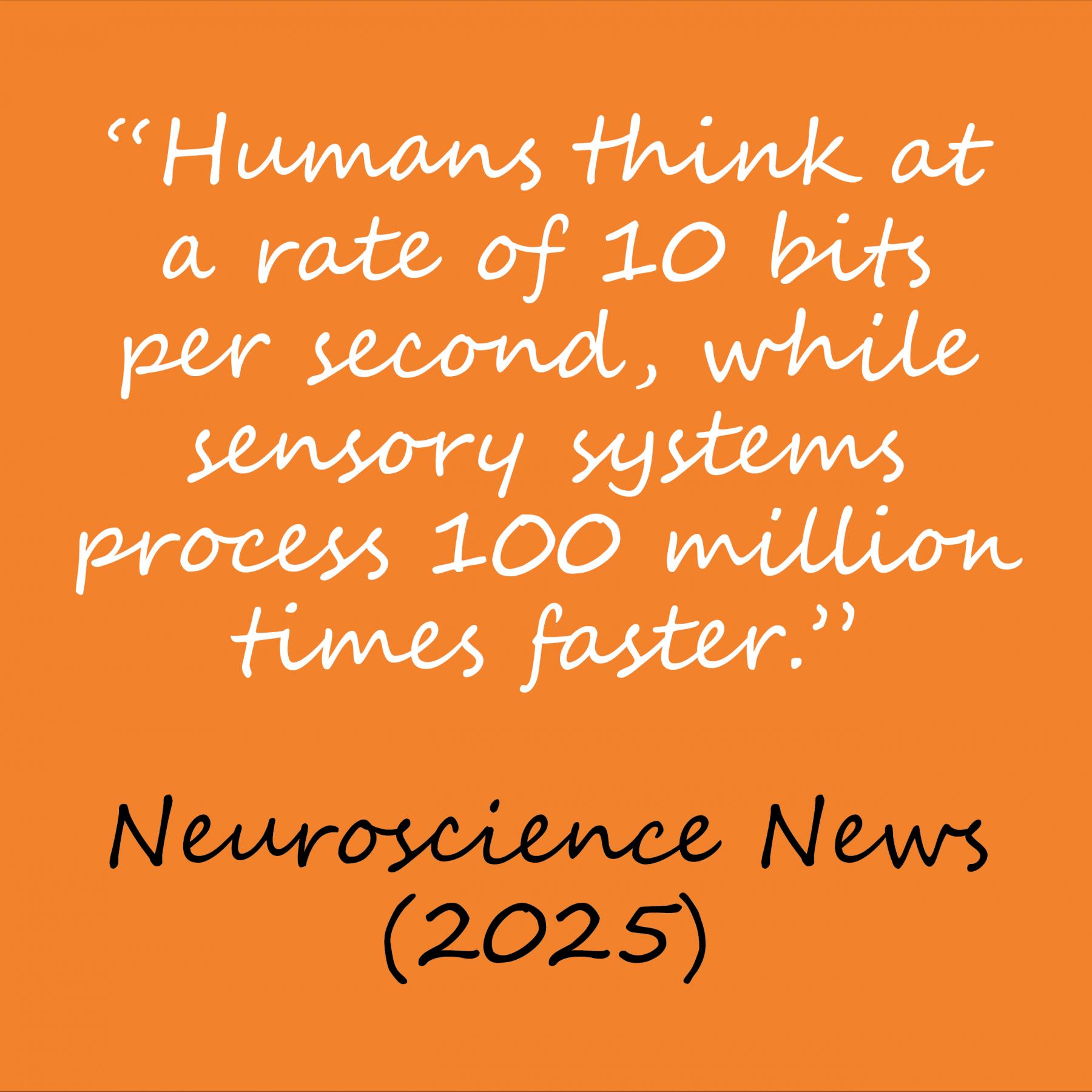
Research* published December 2024 suggests that we think rather more slowly than we might have realised, at a mere 10 bits per second, the equivalent of one short sentence per second. In comparison, standard WiFi processes information at around 50 million bits per second. Yes, you read that right.
Neuroscientists have said for a long time that thinking is not the primary purpose of the brain (operating survival functions is). Now it seems that thinking is way less useful than we realised.
Like a stuck record
What might this mean for us and our mental agility? And if you can’t think your way into being mentally fit, what can you do?
In a recent coaching session, my client was trying to work through a complex people issue. The more they thought about it, the more stuck they seemed to become. It’s a familiar pattern; we often assume that if we just think a bit harder, or longer, we’ll solve the problem. The issue is, thinking has limits.
If conscious thinking is relatively slow, it makes sense why overthinking is so exhausting and, often, unproductive. You’re trying to process complex, fast-moving situations using a narrow, limited channel.
Expanding your senses
While thinking is slow, in contrast, your sensory systems are taking in vast amounts of information rapidly. Tone of voice, facial expression, body language, the atmosphere in a room. You’re picking all of this up, often without realising it. What’s often missing is trusting what you’ve already picked up.
This is where mental agility is often misunderstood. It’s easy to think of it as being quick-thinking or intellectually sharp. That’s part of it, but in practice it’s more about how flexibly you use all the information available to you, not just what you can consciously analyse. It means becoming more aware of your senses and your emotions as an important source of information.
When mental fitness is strong, you’ll be better at noticing what you’re sensing, not just what you’re thinking. You’re more able to pause, rather than forcing an immediate answer. You’re also more willing to test things out, rather than trying to solve everything in your head.
Back to that coaching session; the shift didn’t come from thinking. It came from processing in a different way. In this client’s case, they imagined their people issue as a film set, which helped them see it and feel it differently.
If thinking harder isn’t the answer, what might help?
- Slowing down, even briefly, to notice more of what’s going on.
- Paying attention to your immediate reactions, not just your analysed conclusions.
- Talking things through with someone else, so you’re not relying on your own thinking.
- Being willing to act on a ‘good enough’ sense, rather than waiting for complete certainty.
Mental agility isn’t about faster thinking. In many ways, it’s about knowing when to stop thinking and start noticing.
A coaching question to leave you with:
When you’re trying to work something out, are you relying only on your thoughts…or are you also paying attention to what you’re already sensing?
*Human Thought Lags Behind Sensory Speed - Neuroscience News